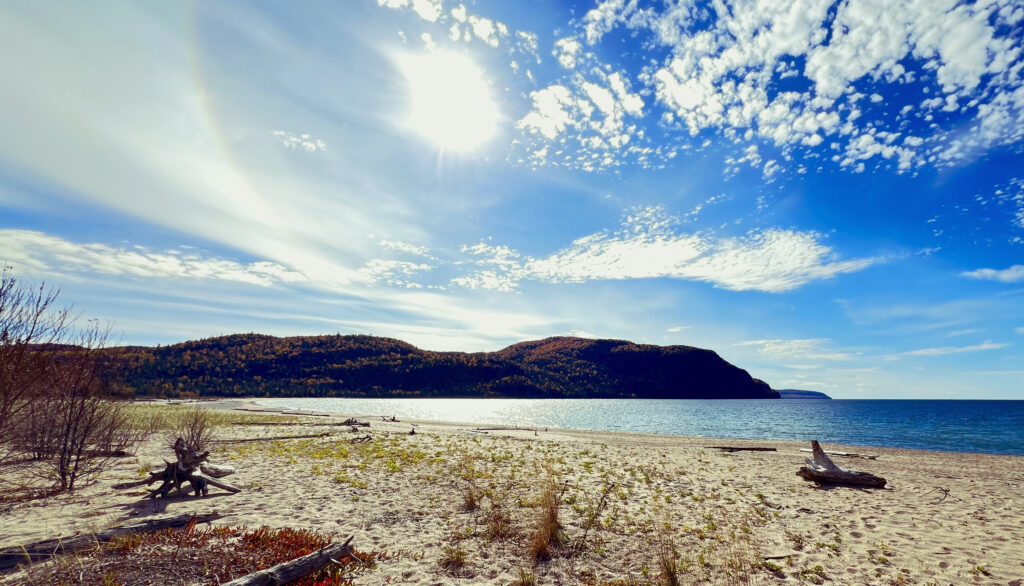
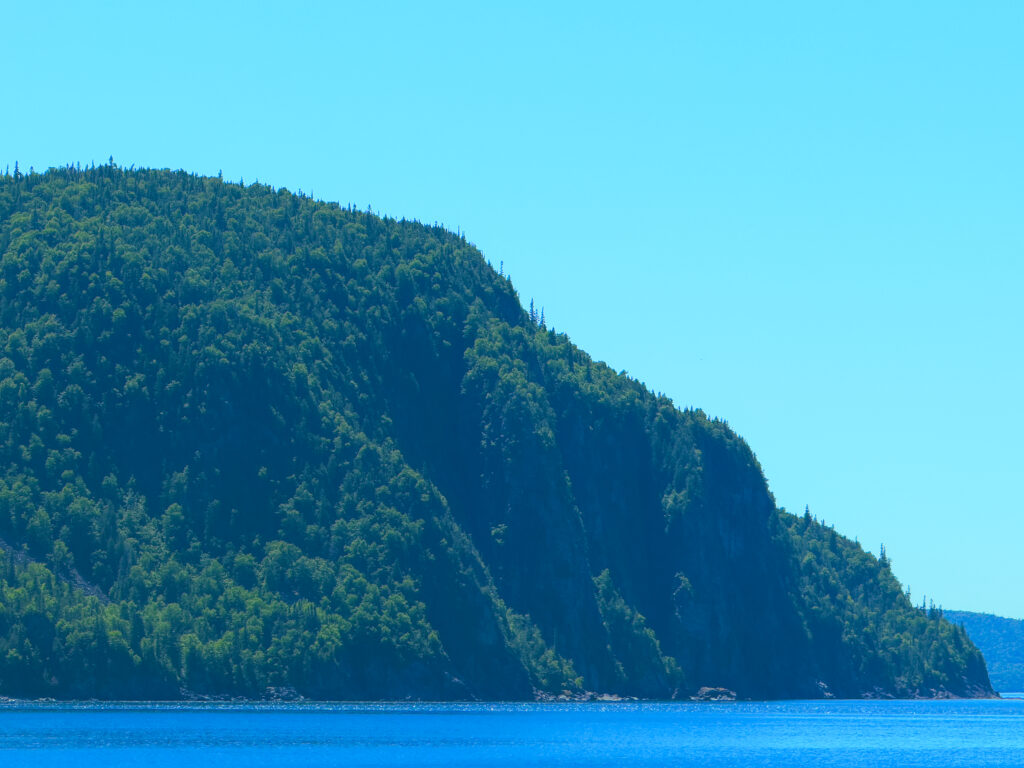
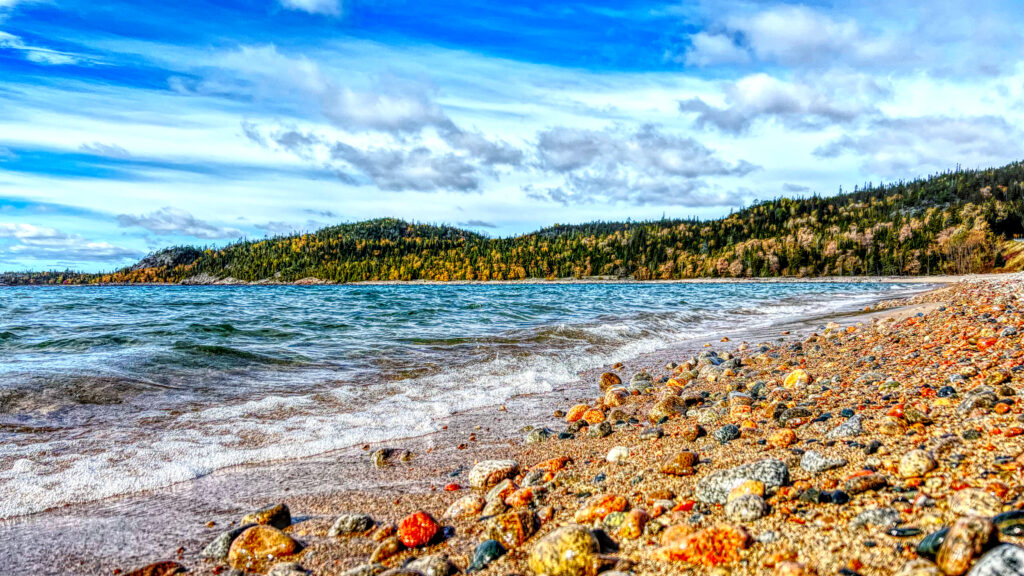
Just off Highway 17 on the eastern shore of Lake Superior, the broad sweep of Old Woman Bay unfolds like a quiet stage: a wide sandy beach, the deep blue curves of the lake, and cliffs that soar some 200 metres above the water. On the shore’s southern edge, one of the granite ridges carries the hint of a human profile — the outline of an old woman gazing out over the lake. The bay takes its name from this cliff-face view, and the story entwines land, water, and tradition.
Landscape & Geology
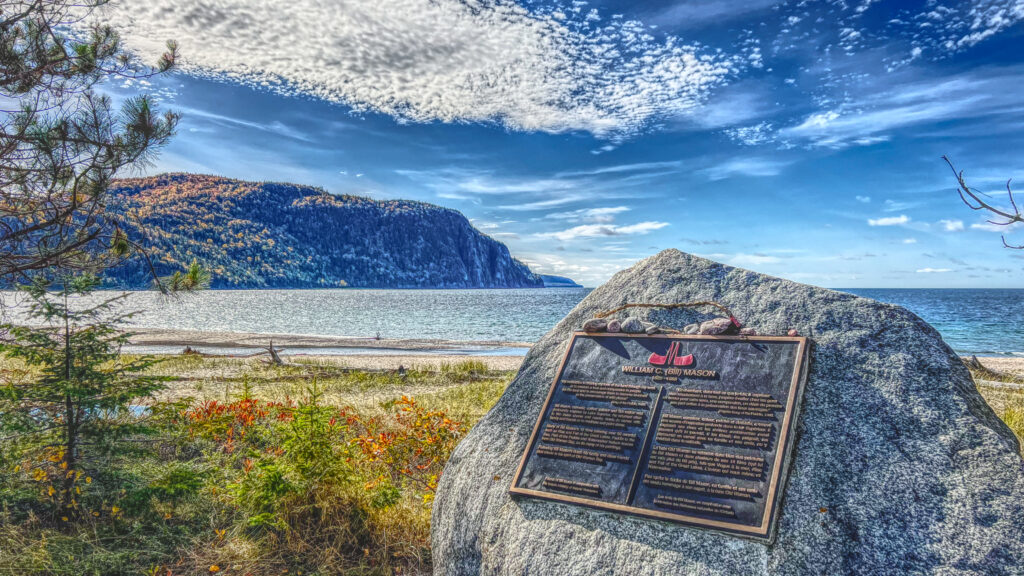
The cliff, the beach, the lake: all of them speak of ancient forces. The rock here is part of the Canadian Shield and belongs to the long story of the Midcontinent Rift system, which about a billion years ago nearly split the continent. Over glacial ages the ice carved the rock and the waves of Superior refined the shoreline until today’s dramatic scene. On calm days the lake lies mirror-still; on stormy days it rises, rolls, and reminds you that this is still big-lake country. A commemorative Plaque is installed in the park remembering Bill Mason. The Plaque Reads:
WILLIAM C. (BILL) MASON
1929-1988
“My motivation of sharing my love of the land through my work is to awaken a love and compassion in people for the land and to encourage them to become involved in the preservation of wild places” – Song of the Paddle, 1988
Bill Mason, canoeist, author, painter and film maker was profoundly inspired by Lake Superior. He returned often to film these shores and nearby rivers, to canoe with family and friends or to meditate and paint alone.
Many of Bill Mason’s 18 films (winning over 60 awards) such as Rise and Fall of the Great Lakes, Paddle to the Sea, Path of the Paddle and Waterwalker feature scenes from Old Woman Bay, as do many of his paintings.
Following Bill Mason’s death his family and close friends paid tribute to his spirit at Old Woman Bay.
Friends of Bill Mason in cooperation with the Ontario Ministry of Natural Resources.
The Legend of the Old Woman
In the oral traditions of the Batchewana First Nation, the place is more than a scenic view. It’s a site of story and meaning. According to local telling:
My grandma used to tell us a story about Old Woman Bay. There was an old woman – I don’t know where she was from – might have been Goulais Bay, might have been Batchewana, I don’t know. But anyway, they called her Chikwewiss. She was a bad old lady and she did things to the people. Practiced bad medicine on them and all sorts of things. Punishment in them days was banishment so they banished her. They banished that old woman out of whatever reserve that was. When they were chasing her down, she broke her leg going down to the ice in wintertime. Grandma used to say, the story is when you’re on the ice, you can hear like, “Chk-chk-whoosh, chk-chk-whoosh.” That’s the old woman dragging her leg, going up the lake. She was banished up to Old Woman’s Bay. That’s how far she crawled. She tried to crawl up the land and she crawled up the rocks on the mountainside and that’s how Old Woman Bay is supposed to have gotten its name. When we were kids, we would go by Old Woman’s Bay and my dad would point out, “There she is in the rock!” You could see her face in the rock and her hair would come down like that.
– Chief Dean Sayers, Batchewana First Nation
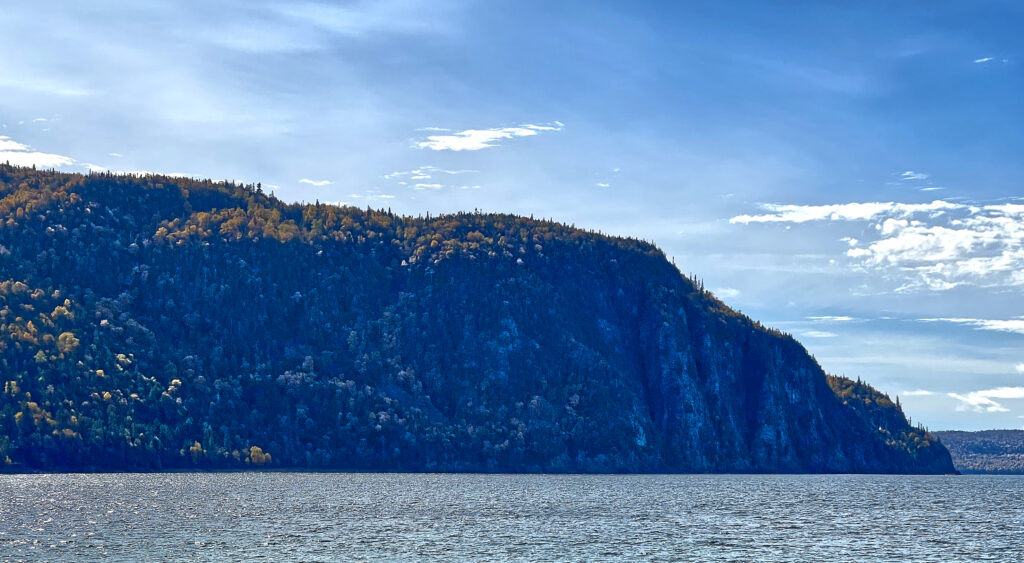
The image seen high on the granite cliff that guards its southern edge — a rock face that, when viewed from a distance, resembles the profile of an old woman looking out across the water. For generations, travelers along this coast have known the place by that feature. In Anishinaabe tradition, the figure is sometimes associated with Nokomis, the wise grandmother spirit of creation and knowledge.
Cultural & Travel History
For centuries, Anishinaabe peoples travelled these shores and waters — paddling, trading, fishing along the Great Lake (Gichigami) and its shoreline. Later, voyageur and fur-trade routes followed the same coast. The cliff and the bay were landmarks, shelters, and reminders of the lake’s power. Today, Old Woman Bay is a favourite stop: visitors walk the beach, gaze up at the cliff, feel the spray of the lake, and sometimes pause at sunset when the rock glows gold and the face seems to come alive in the light.
Why the Bay Matters
When you stand on that sand, by the rocking surf of Lake Superior, you’re standing in a place that holds many threads: the deep time of rock and ice, the travels of people across the centuries, and the stories of meaning and spirit that dwell here. The “old woman” is at once a shape in the cliff, a character in a legend, and a voice of this place. She reminds us that landscapes are not just scenery — they are story, memory, and lived experience.